
The 2026 Startup Surge: Why the International Entrepreneur Parole (IEP) is the New ‘Startup Visa’

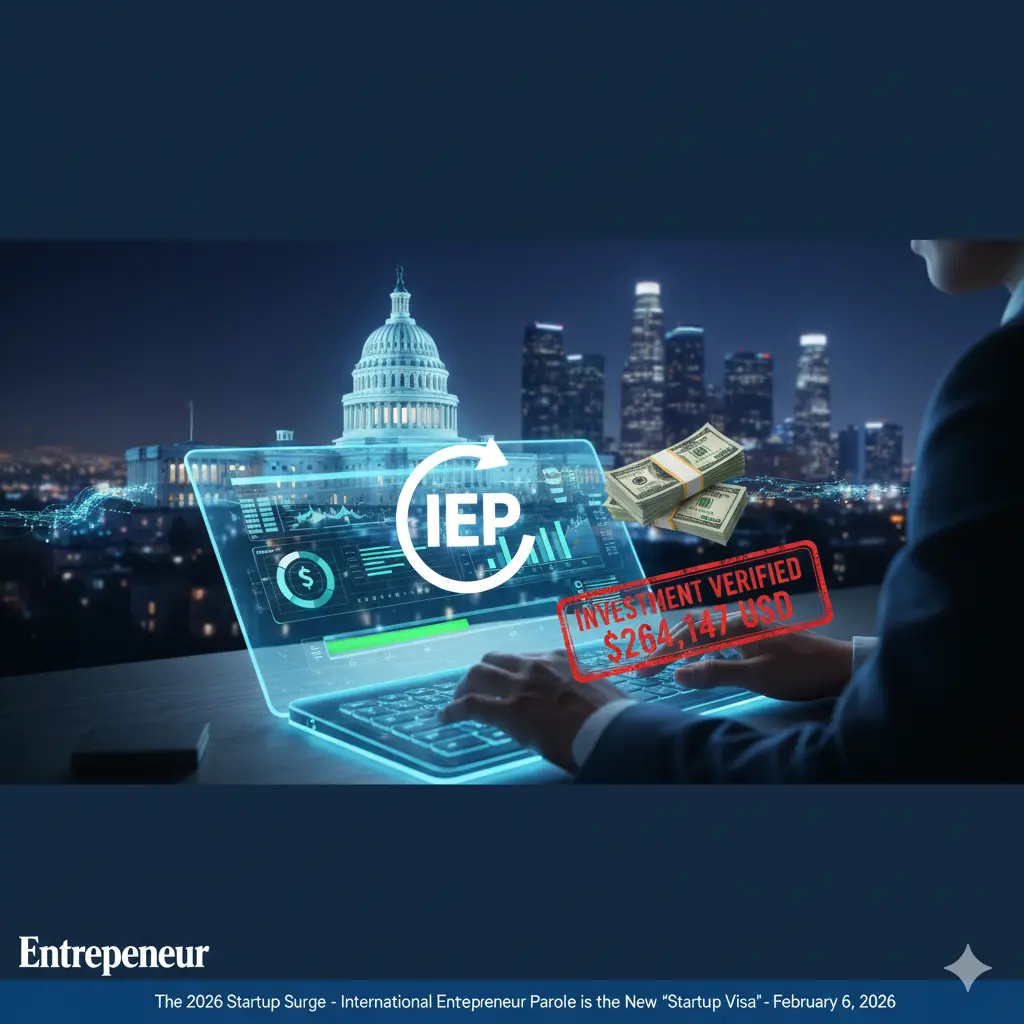
By Entrepreneur Leadership Network | Published: February 6, 2026
SILICON VALLEY – For years, foreign-born founders have lamented the lack of a dedicated “Startup Visa” in the United States. However, as we move into 2026, a formerly underutilized pathway—the International Entrepreneur Parole (IEP)—has officially become the go-to strategy for international business owners. According to a recent analysis by Entrepreneur, the IEP is now being hailed as the most viable alternative to the increasingly competitive H-1B and EB-1 visa categories.
Why the IEP is Trending in 2026
With the H-1B lottery shifting to a “wage-weighted” system and EB-5 capital requirements remaining high, the IEP offers a unique middle ground for venture-backed founders.
- The “Public Benefit” Factor: To qualify in 2026, entrepreneurs must demonstrate that their startup provides a “significant public benefit” through rapid growth and job creation.
- Investment Thresholds: Current regulations require the startup to have received at least $264,147 from qualified U.S. investors (VCs or angels) or at least $105,659 in government grants.
- Ownership Stake: The entrepreneur must hold at least a 10% ownership interest in the startup and play a central, active role in its operations.
The “Bridge” Strategy
Immigration experts featured in Entrepreneur emphasize that the IEP is rarely a permanent solution but rather a powerful “bridge.” “We are seeing founders use the IEP to enter the U.S., scale their operations, and then transition into the EB-1A (Extraordinary Ability) or EB-2 NIW (National Interest Waiver) for permanent residency,” says a lead immigration attorney. This two-step approach allows founders to bypass the long wait times associated with direct Green Card applications.
2026 Policy Shifts: Remote Inspection & Increased Fees
Entrepreneur also highlights two critical changes that business owners must budget for this year:
- Inflation-Adjusted Fees: As of January 1, 2026, USCIS has implemented a new round of inflation adjustments, raising the cost of premium processing to $2,805.
- Digital Verification: The rollout of permanent remote I-9 inspections for E-Verify employers has simplified hiring for tech startups, allowing foreign founders to manage distributed teams across the U.S. more efficiently.
Advice for Global Founders
For those looking to launch in the U.S. during the 2026 World Cup economic boom, the advice is clear: Align your immigration and fundraising timelines. A successful IEP application depends heavily on the “track record” of your U.S. investors, making the choice of venture partners as much a legal decision as a financial one.
Sources:
- Entrepreneur Magazine: Immigration & Business Strategy (2026 Update)
- Department of Homeland Security (DHS) Final Rule on Entrepreneur Parole
- Fennemore Law: Business Immigration Takeaways for 2026