
The Economic Toll of U.S. Visa Delays: UAE Businesses Brace for Long-Term Impact

By Arabian Post Business Desk | Published: February 6, 2026
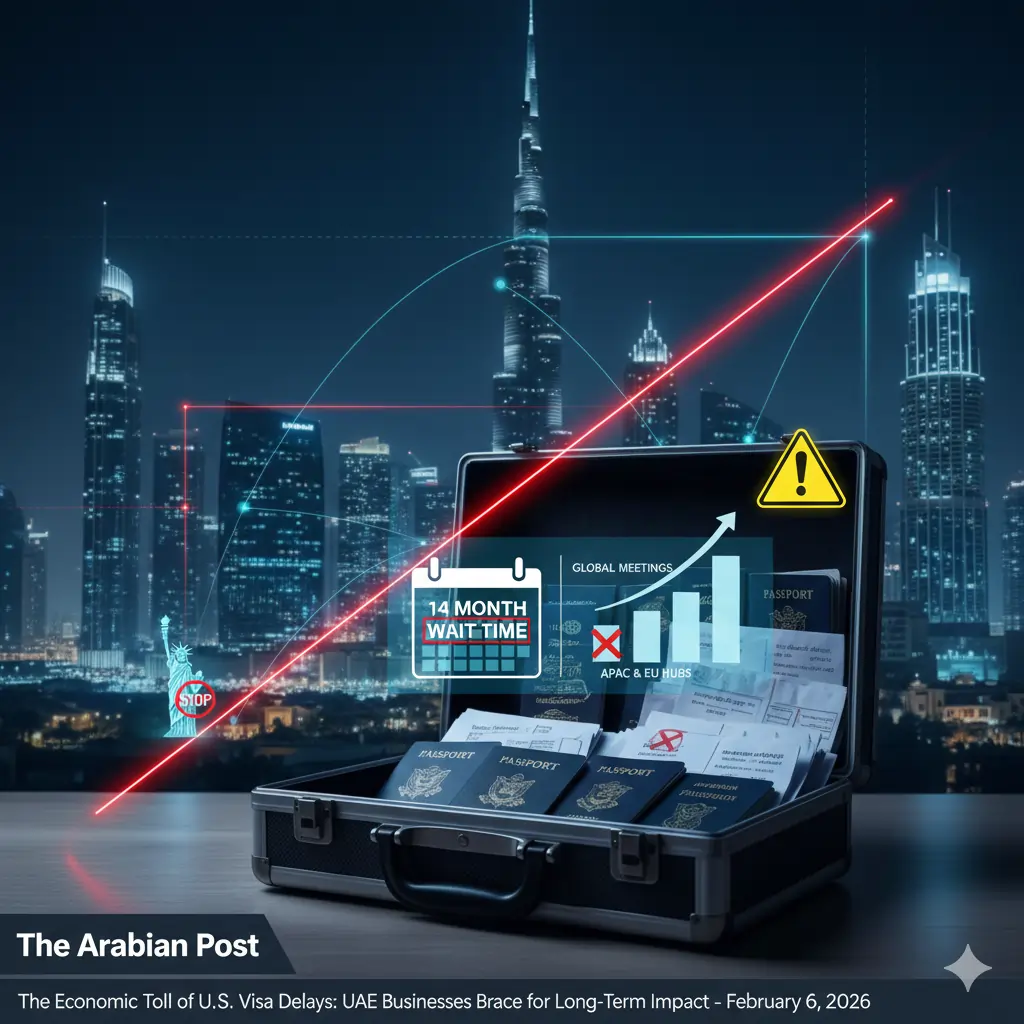
DUBAI, UAE – As the United States implements its most restrictive immigration and travel policies in decades, the fallout is being felt across the UAE’s corporate landscape. A new report by The Arabian Post highlights how the combined effect of the “immigrant visa suspension” for 75 countries and the staggering 14-month wait for visitor visas is forcing UAE firms to rethink their global strategies.
Corporate Stagnation and “Meeting Fatigue”
For many Dubai-based multinationals, the inability to send key personnel to the U.S. for strategic planning or the 2026 World Cup marketing activations has led to significant operational friction.
- The “Wait Time” Crisis: With Abu Dhabi hitting a 14-month backlog for B1/B2 visas, companies are increasingly shifting their annual summits and board meetings to neutral hubs like Singapore or London.
- Contract Risks: Several UAE-based tech firms have reported lost contracts because engineers holding “restricted” passports (from the list of 75 countries) could not secure entry for on-site implementation in the U.S.
The Rise of the ‘Citizenship Pivot’
The Arabian Post has observed a surge in demand for second citizenship programs among high-level executives. “The U.S. policy in 2026 has made a second passport a business necessity, not a luxury,” says a wealth manager in DIFC. By acquiring citizenship from a country not on the “75-country suspension list,” executives are attempting to bypass the indefinite freeze on immigrant visa processing.
Financial Burden on Families
It’s not just the corporate world feeling the pinch. The new $250 Visa Integrity Fee and the $5,000+ Visa Bonds have made U.S. travel prohibitively expensive for middle-class expatriate families in the UAE.
- The Math: A family of five now faces nearly $2,000 in non-refundable fees before even factoring in the cost of flights or hotels for a simple graduation ceremony or holiday.
Outlook for Q3 2026
While the U.S. government maintains that these measures are essential for “national security and financial self-sufficiency,” trade bodies in the UAE are calling for a more nuanced approach. “The current blanket restrictions do not account for the high-compliance environment of the UAE’s resident population,” noted an analyst in the report.
Unless a reciprocal agreement or a specialized “Business Corridor” is established by late 2026, the trade volume between the two regions could see its first significant dip in over a decade.
Sources:
- The Arabian Post: Economic Policy Analysis (February 2026)
- UAE Chamber of Commerce: International Trade Briefing
- US-UAE Business Council: Quarterly Mobility Report